
Introduction
Hello nursing students! When you enter the world of anatomy and physiology, you are suddenly introduced to a completely new medical vocabulary. Words like superior, inferior, anterior, and posterior start flying around. To understand these terms without getting confused, there is one foundational topic you must master first: Planes and Sections of the Human Body.
If you look at standard textbooks like PR Yadav, this topic might look like just a few short definitions. However, examiners love to ask direct questions about anatomical planes in both college exams and competitive tests like NORCET.
In this blog post, we will break down the Sagittal, Frontal, and Transverse planes into the simplest English possible. No heavy medical jargon, just real-life examples and practical explanations so you can visualize them clearly and score full marks. Let’s dive straight into it!
What are Anatomical Planes and Sections?
Before diving into the types, let us first understand what these words actually mean in simple nursing language.
Anatomical Plane: Imagine an imaginary flat sheet of glass passing through your body. That imaginary flat surface or line is called a Plane.
Anatomical Section: When you actually cut the body or an organ along that imaginary plane, the flat surface you get to see is called a Section.
Why do we need them?
In hospitals, when doctors look at an X-ray, CT scan, or MRI, they see images of the body cut into different slices. To understand those slices and internal organs properly, every healthcare professional must know the proper Planes and Sections of the Human Body. Without this basic knowledge, it is impossible to read diagnostic reports correctly.
The 3 Main Types of Planes and Sections of the Human Body
According to medical science, there are three primary planes that cut the human body at different angles. Let’s look at them one by one to see how they help us study human anatomy.
1. Sagittal Plane (The Left and Right Divider)
The word Sagittal comes from a Latin word meaning “arrow”. Imagine an arrow piercing through your body from front to back.
Definition: A Sagittal plane is a vertical (straight up and down) plane that divides the human body or any organ into Right and Left sides.
Midsagittal (Median) Plane: If this vertical line passes exactly through the middle of the body and divides it into two equal right and left halves, it is called a Midsagittal or Median plane.
Parasagittal Plane: If the vertical line is slightly away from the center and divides the body into unequal right and left parts, it is called a Parasagittal plane.
Real-Life Example: Imagine cutting an apple straight down from the top stem right through the middle into two sides. That is a midsagittal cut!
2. Frontal or Coronal Plane (The Front and Back Divider)
The word Coronal comes from “crown”. Imagine wearing a crown or a headband that goes over the top of your head from one ear to the other.
Definition: A Frontal or Coronal plane is a vertical plane that divides the entire body or an organ into Anterior (Front) and Posterior (Back) portions.
Clinical Importance: This specific category of Planes and Sections of the Human Body helps us study the organs inside the chest or abdomen from a front-facing view without mixing up the front and back structures.
Real-Life Example: Imagine slicing a loaf of bread sideways to make slices for toast. If you slice a human body like that from side, you get a frontal section!
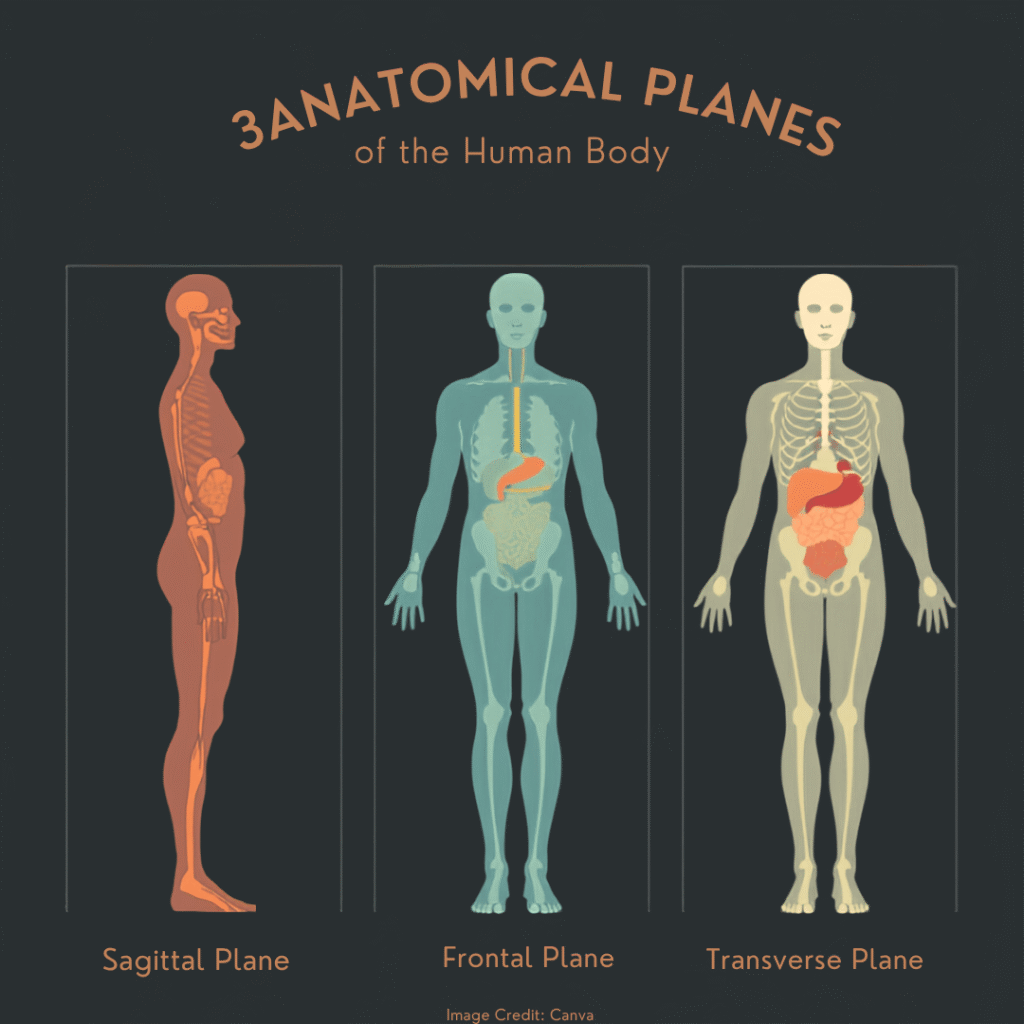
3. Transverse or Horizontal Plane (The Top and Bottom Divider)
This is the easiest plane to visualize because it does not go up and down; it goes sideways.
Definition: A Transverse plane (also known as a cross-sectional or horizontally plane) cuts the body horizontally. It divides the body or an organ into Superior (Top/Upper) and Inferior (Bottom/Lower) portions.
Clinical Importance: Most CT scans and routine abdominal ultrasounds show the organs in a transverse view. It helps doctors see the cross-section of blood vessels, intestines, and nerves.
Real-Life Example: Think of a chef cutting a cucumber into round slices. Each round slice is a transverse section!
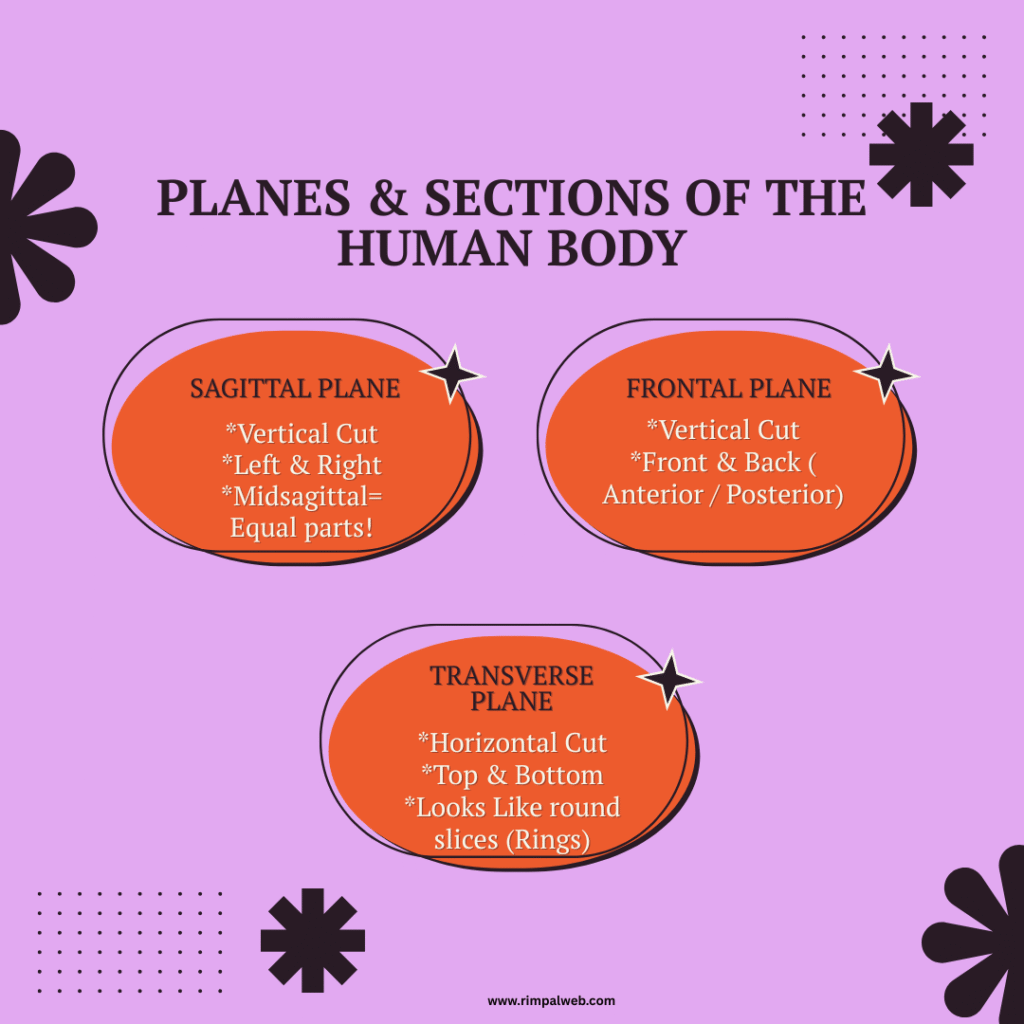
Visual Summary: Planes & Sections
” Need a quick look at the main concepts? This visual summary makes memorizing the anatomical planes easy and effective.”
What is an Oblique Plane? (Bonus point for Extra Marks)
Apart from the three main Planes and Sections of the Human Body mentioned above, there is one more minor plane that you should know to score extra marks in your nursing exams. It is called the Oblique Plane.
Definition: An oblique plan passes through the body or an organ at an angle (diagonal or slanted cut). It is not straight like vertical or horizontal cuts.
Example: Cutting a loaf of garlic bread at a sharp angle to make diagonal slices.
Conclusion & Exam Tips
Mastering the various Planes and Sections of the Human Body is your first major step toward learning advanced medical surgical nursing and diagnostic imaging. Whenever you get an exam question about this topic, always remember to draw a quick stick-figure diagram showing the three axes—this will immediately fetch you higher marks from your examiners.
I hope this easy English guide made your concepts clear! If you found these anatomy notes helpful, please share them with your fellow nursing students. Stay tuned for our next blog post where we will unlock the secrets of the human Cell and Tissue!
If you have any questions or doubts regarding these planes, feel free to drop a comment below. Happy learning!
Further Reading
To understand more about human anatomy and physiology, you can explore my other guides:
How the body functions, you should also read my guide on the 6 Basic Life Processes of Human Body: Anatomy and Physiology Easy Notes.
If you want to know about how the body is built, check out the 6 Levels of Structural Organization in the Human Body.