
1.”Welcome Nursing Aspirants! If you are preparing for nursing exams like NORCET, GNM, or B.SC Nursing, Anatomy & Physiology can sometimes feel very difficult. Today, we will simplify Chapter 1 of the famous PR Yadav Book and learn all 6 levels of structural organization of the Human Body in the easiest way possible. Let’s make learning simple!”
What is Anatomy and Physiology?
- Anatomy: It is the study of the structure of the human body.
- Physiology: It is the study of the functions of the body parts.
Easy Example to Remember:
Anatomy is like looking at the fixed parts of a car, and Physiology is learning how of a car actually drives on the road!
2.The 6 Levels of Structural Organization
” Our human body is like a big building. To understand it, we have to look at its 6 structural levels, from the smallest atom to the complete body:”
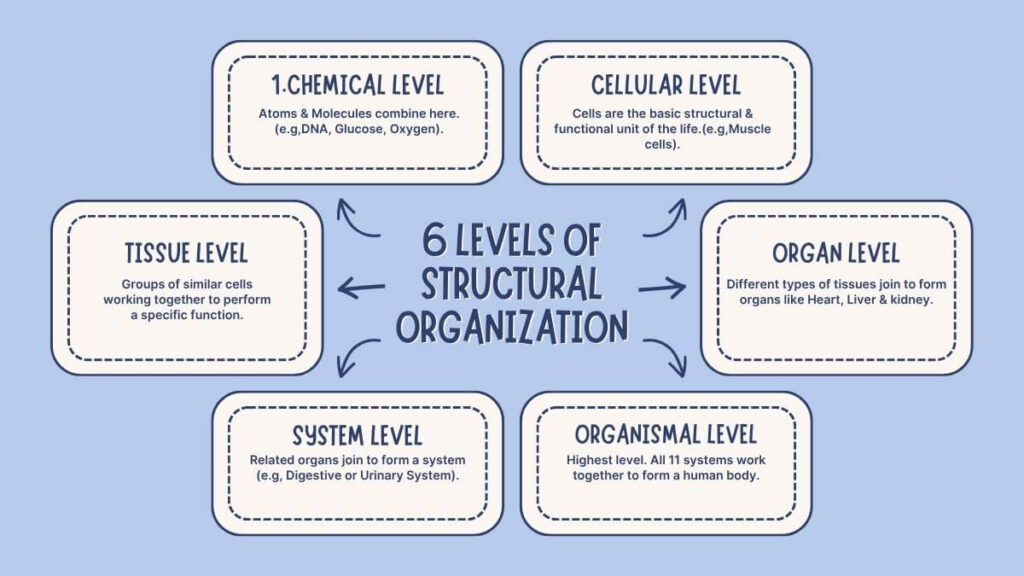
1.Chemical Level
This is the lowest and smallest level. Our body starts with Atoms and Molecules (like Carbon, Hydrogen, Oxygen).
MTG Exam Booster:
- Direct Question: “Which is the most abundant element in the human body by mass?”
- Answer: Oxygen(65%).
- Next Target Point: Atoms combine to form Molecules. In nursing exams, remember that DNA(Deoxyribonucleic acid) and Glucose are examples of molecules at the chemical level.
2.Cellular Level
When molecules combine, they form Cells. The cell is the basic structural and functional unit of life. (Examples: Muscle cells, Nerve cells, Blood cells).
3.Tissue Level
A group of similar cells working together to perform a specific function forms a Tissue. (Examples: Epithelial tissue, Connective tissue).
4.Organ Level
When different types of tissues join together, they form an Organ. Every organ has a specific shape and function. (Examples: Heart, Stomach, Liver, Brain, Lungs).
Clinical Condition: Organ Failure
- Explanation: When cell damage starts to occur at the tissue level, that whole organ (like the Liver or Kidney) begins to fail. This is what we call ‘Organ Failure’.
- Nursing Care: When a system (like the Urinary System) fails, its effects start to be seen at the whole Organismal level( the patient’s whole body).This is why doctors and nurses have to catch disease at the early levels.
5.System Level
A group of related organs working together for a common function forms a System. For example, the Stomach, Esophagus, and Intestines join together to make the Digestive System.
6.Organismal Level
This is the highest level. When all 11 organ systems of the body work together, they form a complete living human body- an Organism.
3.Quick Revision Flowchart
Shortcut to Remember the 6 Levels
- ATOMS
- CELLS
- TISSUES
- ORGANS
- SYSTEMS
- HUMAN BODY!
“The diagram below perfectly illustrates the 6 Levels of Structural Organization of the human body.
Frequently Asked Questions (FAQs)-6 Levels of Structural Organization
To help you clear your doubts for exams like G.N.M, B.SC Nursing, or NORCET, here are some important questions and answers from PR Yadav Book Chapter 1:
Q1: What is the correct sequence of the levels of structural organization?
Ans: The correct sequence from smallest to largest is: Chemical Level, Cellular Level, Tissue Level, Organ Level, System Level, Organismal Level. Always remember this specific order for your multiple-choice questions (MCQ).
Q2: At which level does life actually begin?
Ans: Life officially begins at the Cellular Level. Cells are the smallest living units in the human body. The chemical level (atoms and molecules) is non-living.
Q3: What constitutes and organ level of organization?
Ans: An organ is composed of two or more different types of tissues that work together to perform a specific, complex function. Example include the stomach, heart, and liver.
Q4: What is understanding these levels important for nursing students?
Ans: Understand these levels helps you learn how the human body is built from scratch. It makes it easier to understand advanced topics in Anatomy and Physiology, which is highly beneficial for your semester exams and competitive tests.
“You can read more about human body levels on the official Wikipedia page.”
Key Takeaways for Quick Revision
Before you finish reading, let’s quickly summarize the most important points from PR Yadav Chapter 1 so you can score full marks in your exams:
1.The Non-Living Base: The Chemical Level is the foundation of the body but it is entirely non-living.
2. The Spark of life: Actual cellular life and biological activities trigger only from the cellular level.
3. Complex Network: Tissues from organs, and organs group together to create complete organ systems like the digestive or cardiovascular systems.
4.The Final Product: All these systems cooperate beautifully to keep the entire Organismal Level functioning perfectly.
4.Conclusion
“Hope these PR Yadav Chapter 1 notes on 6 Levels of Structural Organization helped you clear your concept! In the next blog post, we will discuss Basic Life Processes (Metabolism).
If you have any doubts or questions, please comment below and let me know. Happy Studying!”